RANKED: The biggest disadvantages to career growth
Aug 23, 2026
Find Your Superpower newsletter 144
Read time: 7 minutes
Topics covered: Executive positioning, Brand Builder Mastermind Sep cohort LAST CALL!
Since the COVID pandemic, I have helped thousands of professionals build their professional identities and personal brands, and for the past few years I have worked closely with over 200 executives, business owners and consultants inside my flagship 12-month Brand Builder Mastermind on four pillars: building a powerful brand, speaking better, writing better, and monetizing all of it.
From that vantage point, you start to see the same handful of problems show up again and again in people who are otherwise excellent at their jobs.
So I decided to rank them, from C-tier (least damaging) to S-tier (most damaging). I have personally lived with most of these at some point, and I suspect you'll recognize a few of your own.
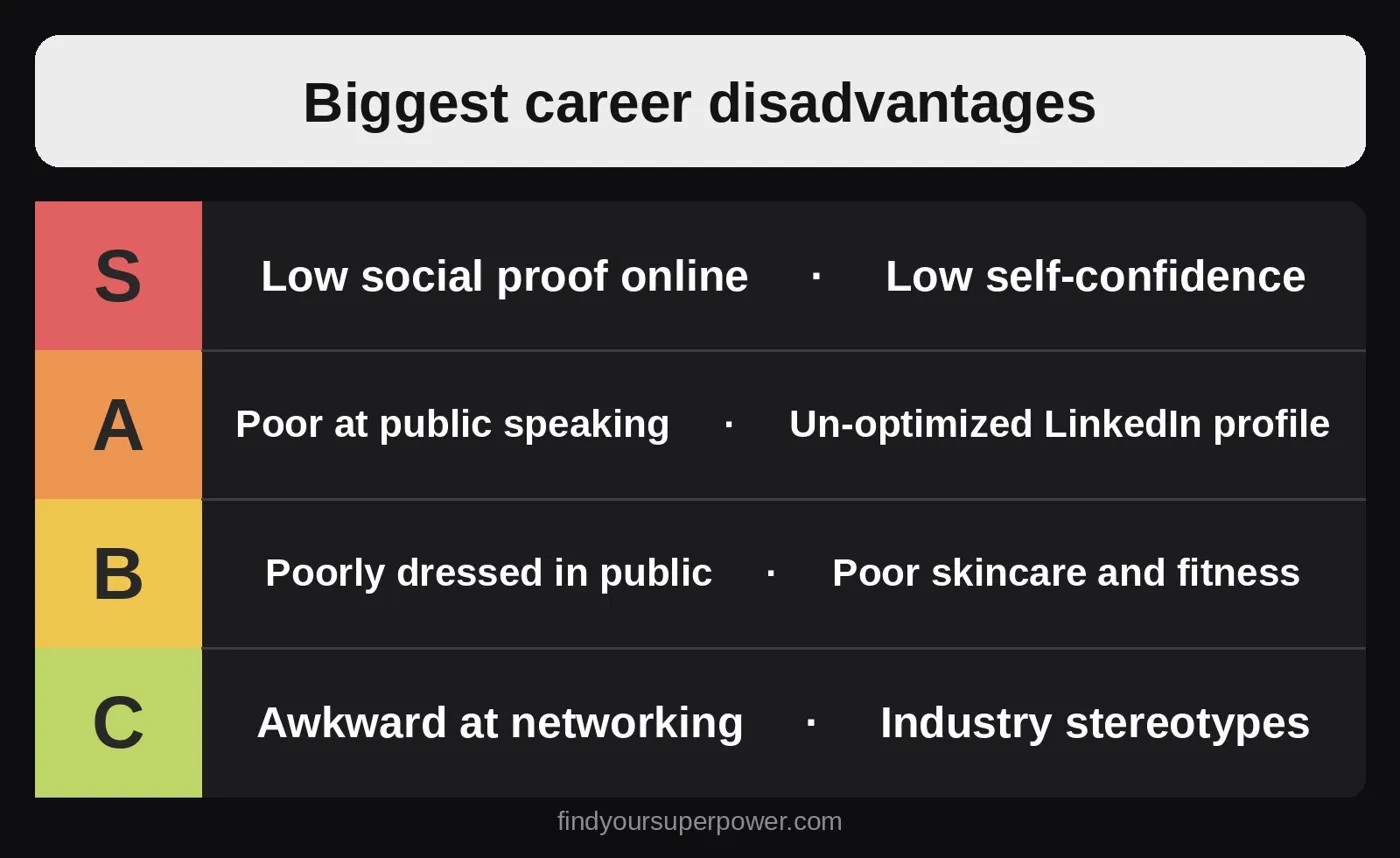
The biggest disadvantages to career growth, ranked
C-tier
Industry stereotypes. Finance and legal experts tell me nobody expects them to be funny and interesting. Scientists and engineers tell me they can't be expected to communicate their technical work to the general public. I believed the same about myself for years as a university professor and academic. Having coached thousands of industry experts since, I have learnt that it is the excuse we give ourselves so that we don't have to invest effort into the harder work further up this list. The first step to unlocking a whole ocean of goodness is to change our mindset.
Awkward at networking. Learning how to network is a core skill that every young executive needs to grasp. That said, if you are truly awkward at it, the answer is not to keep forcing yourself to show up at random networking events and being cruel to yourself. It is to network strategically, the way I do, by learning the concept of attraction marketing using your content as a magnet to draw the right people to you. I like to say that every time I post on LinkedIn, I take on 30-50 preliminary coffee meetings in one morning. And from the comments and DMs that flood my inbox, I pick the person I truly resonate with for an actual coffee meeting, and that often turns into a real friendship or business partnership within a single cup. Look how much more fun and relaxing that sounds? Always trust a scientist who tries to optimize for better outcomes, haha.
B-tier
Poorly dressed in public. People read status in seconds, and clothing is one of the fastest signals that we have in our arsenal of professional branding tools. I have watched men and women with high net worth and solid bank accounts turn up to events in suits that are too tight or too loose, un-ironed and stained, with sleeves and trouser lengths way too long or too short. For women, it's often clothes that are baggy and shapeless, 100% black to blend into the background, because the outfit was chosen to be invisible rather than to be seen. This has nothing to do with luxury designer labels. A tailored $200 blazer beats a poorly-fitting $2,000 one every time.
Poor skincare and fitness. The executive who looks tired, exhausted and disheveled does not get promoted to leadership roles, and does not get put in front of the camera, the client or the conference audience, however sharp their thinking is. With every wellness and aesthetic option available to us today, from serums to Hyrox, there is honestly no excuse for saying you can't find something that appeals to you. Exercise generates strong, positive energy. Good skincare and haircare signal self-care and self-respect, and both are part of your professional brand whether you are aware of it or not.
A-tier
Poor at public speaking. If there is one skill that will hugely increase your lifetime earning potential, it would be to ace every keynote, panel, townhall, board interview and media appearance you are invited to be a part of. In Asia we over-index on technical knowledge, on A* grades and perfect exam scores, and forget to teach our kids how to debate and communicate candidly. The result is a generation of grown-ups who only feel comfortable speaking if everything is written down or memorized, when the best leaders can communicate off the cuff. If you freeze, ramble on or read your PowerPoint slides aloud, the organizer won't invite you back, and they will never tell you why.
Un-optimized LinkedIn profile. When a journalist, conference organizer or recruitment firm hears your name, they will immediately search for you online, and LinkedIn is usually where they start for most industry niches. A headline that says "Senior Manager at Company X" above an empty About section tells that stranger you are a commodity, interchangeable with every other mid-career executive. Your profile is your digital storefront, open 24/7, even when you sleep, go on vacation or go on medical leave. Is your store closed or open 365 days a year? Mine sure is open for business all year round, and I received offers for gigs even while I was on vacation in Bangkok earlier this week.
S-tier
Low social proof online. When I Google your name, what comes up? Someone with an identical name who is more famous than you? A catfishing headshot from years ago that no longer looks like you? No interviews with CNBC or Channel NewsAsia? No industry association blog recapping the workshop or keynote you gave and summarizing your ideas? No video of you speaking powerfully on stage and commanding an audience? No alumni, charity or non-profit committee activities? No upcoming talk at a top industry conference like Reuters and The Economist? You cannot be chosen by decision makers who don't know you exist, and the cruel part is that those with social proof sweep up all of the opportunities, when others get none.
Low self-confidence. This sits at the very top because it is upstream of everything else. It's why you don't post, why you don't put yourself forward for the panel, why you say "I'm not ready, I'll be ready when <insert random excuse>." I know people who instantly label everything I teach as "cringe" or "corny." What is really happening is that they are putting a negative label on professional brand positioning to protect themselves from the effort of having to take action. They're creating an imaginary barrier between themselves and a desirable, financially rewarding goal, because change is scary and status quo feels a lot more comfortable, much like a warm blanket.
The good news
Not one item on this list is permanent. Every disadvantage here is a skill or a habit, and skills and habits respond to deliberate, repeated effort and an empathetic branding coach who understands how to play Good Cop-Bad Cop with you.
Your professional brand identity is ultimately a set of learnable skills that you build on purpose so the right people come to know you, like you, trust you, and eventually hire you, invite you or buy from you.
Ready to unlock your S-tier?
This is the work we do every week inside my 12-month Brand Builder Mastermind, across our four pillars:
✅ Build a powerful brand with signature content that attracts clients to you
✅ Speak with confidence on stage, on panels and on camera
✅ Write attractive content and a LinkedIn profile that sells for you while you sleep
✅ Monetize your expertise through consulting, speaking and career growth
Please let me help you become impossible to ignore.
I wake up each morning to help my clients and Mastermind members succeed.
LAST CALL for the Brand Builder Mastermind September cohort!
LAST CALL for the Brand Builder Mastermind September cohort!
LAST CALL for the Brand Builder Mastermind September cohort!
Your rocketship captain,
Juliana 🚀
P.S. Which tier are you stuck in right now? Let me know!